
Want more clients to find you in Google and book your interior design services?
Then this is the guide for you. Compact and jargon-free, this guide to SEO for Interior Designers will help you set up your website to rank in Google and AI search in a few simple steps. That way you have a handy client-attraction process serving your business.
If you’ve been avoiding SEO because it sounded dreary or technical, allow me to reframe. Think of SEO as your most connected publicist: the one who gets you seated at the best table, mentioned in the right rooms, and chosen by clients who appreciate good taste.
What Is SEO? — and Why It Matters for Interior Designers
Search Engine Optimisation is simply how you help the right people find you online. In a world where trillions of searches happen each year (yes, 5 trillion, Google estimates), your name should appear precisely where discerning clients are looking.
Google is that well-informed friend who only recommends what’s elegant, trustworthy, and beautifully executed. To earn that recommendation, your website must signal three things:
- Quality: Content that reads like good conversation, not corporate speech. Useful, engaging, and unmistakably you.
- Authority: Clarity about your expertise and aesthetic. A point of view clients can recognise.
- Experience: A website that feels effortless: intuitive, refined, quick to load, and a pleasure to browse.
- Credibility: Links from and to reputable sources—your digital word-of-mouth.
Is It Too Late to Start SEO?
Does Tequila taste bad? The short answer is that it’s never too late to get found. Even a few thought out tweaks can transform your visibility and deliver enquiries for years. If you’re launching a new website, this post will show you how to start strong. If you’re established, use the SEO tips here to refine and rise through the rankings.
Two Ways to Approach SEO You Need to Know
There are two essential layers that helps get your SEO up and running and your website found.
- On-site SEO setup: the architectural plan—how your website is built, labelled, and structured so Google knows exactly who you are and who you serve.
- Content-led SEO: the ongoing storytelling—blog posts, features, guides, and case studies that expand your reach and authority.
Start with the structure. Then, if you wish, layer in content like a beautifully curated collection.
Five Ways Interior Designers Should Use SEO On Their Websites
Begin with Intentional Keywords
Keywords are simply the phrases your future clients type into Google. Start with your name, your craft, and your location (if you’re local). Then add your niche.
- Think like your dream client: “interior designer Hong Kong,” “luxury kitchen design Cornwall,” “boutique hospitality interiors London.”
- Use Google’s suggestions to inspire variations clients are actually searching.
- Check search volumes with tools like Ubersuggest or SEMrush—and avoid phrases no one looks for.
Make a curated list: your name + discipline, your location (if relevant), and specific services you wish to be known for.

Place Your SEO Keywords with Intention
Each page deserves one hero keyword—think of this like your keyword in a leading role.
- Homepage: Your signature line. For example: “Zinia Lau, Interior Designer, Hong Kong.” If you work globally, focus on your specialism: “Phillipa Keane, Online Business Coaching for Sustainability Leaders.”
- Services page: Be specific: “Virtual Interior Design,” “Interior Design Photography,” “Bespoke Kitchen Design,” “Luxury Show Home Styling.”
Position your hero keyword near the top of the page. Pair it with an elegant, clear introduction so both your visitors and Google feel instantly at home.
SEO for Interior Designers: Optimise Your Images
Our images do more than dazzle. They can quietly lift your rankings too. Here’s how to get your pictures SEO-ready on the back-end.
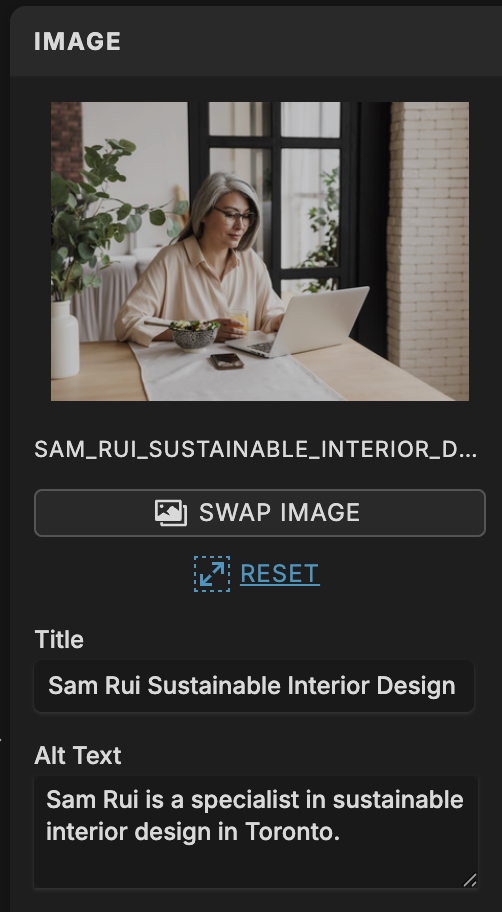
- File names: Rename images before upload with descriptive titles that include your keyword, e.g. “Kirsten-Burrows-interior-designer-Hong-Kong.jpg.”
- Alt text: A brief, natural description that includes your keyword where relevant, e.g. “French-blue kitchen remodel in Hong Kong.”
- File size: Keep pages swift and graceful. Aim for ~1920–2200px width for full-width images and let your platform optimise. If things feel sluggish, resize with a tool like redketchup.io.
A note on restraint:
You don’t need to optimise every image. Five thoughtfully optimised images per page is perfectly polished. Avoid repeating the same alt text—Google does not love monotony.
Craft your SEO URLs and Meta Descriptions
Your URLs should be clean, intuitive, and easy to remember:
- Homepage: jamiejang.com
- About: jamiejang.com/about
- Services: jamiejang.com/interior-design-services
- Resources: jamiejang.com/portfolio
I like to write meta descriptions like the back cover of a beautiful book: enticing, precise, and client-facing. They appear beneath your page title in search results and can make the difference between a scroll and a click.
Structure Your Headings Like a Well-Composed Room
Who knew? Headings aren’t just decorative, they guide your website readers and Google. Here’s the industry-standard on how to use headings so Google reads and ranks your interior design services.
- Use only one H1 per page—this is your showpiece title.
- H2 for your main sections, H3 for elegant sub-notes.
- Keep paragraphs as body text.
This hierarchy makes your content supremely readable—and more discoverable.
Next Steps: Ongoing SEO for Interior Designers
Publish Fresh Content with Purpose
Share case studies, before-and-afters, project breakdowns, room guides, and “How we designed this” stories. Prefer to talk, not type? Transcribe videos you make or podcasts into polished articles. Google counts it—and your audience will adore it.
Add links with Intention
When your website is mentioned somewhere else online, ask them to link back to your site. These backlinks are helpful indicators, showing Google your content is useful enough to be shared. Links in design directories, guesting on another designer’s website or in their editorial, and marketing for any talks or classes you host or guest on are all counted as reputable sources.
Optimise Your Google Business Profile
If you serve a location, claim it, refine it, and encourage reviews. Treat it like a satellite studio—small but powerful, and include details about your services and pictures of your projects or products.
The Shift to AI: Is SEO Still Worth It in 2025?
You may have heard the headlines: Is SEO dead? You may have puzzled over whether AI is “taking over.” And you may have heard of new abbreviations (GEO, anyone?) aiming to help you show up in AI-generated search.
So let’s rip up that old carpet and find out what’s hiding under it.
AI still relies on high-quality content to answer questions—and it discovers that content using the same fundamentals you’re putting in place here. Right now, large sites dominate, but as the ecosystem matures, considered, trustworthy niche expertise will shine. Your job? Google themselves have said it best: Create “high-quality, helpful, reliable content.”
No gimmicks. Just good info.
What Content Works Best for AI Search?
Most people use search to answer their questions. And that’s where you can really shine. Think about the questions your clients always ask—and provide solutions.
- What does the process look like?
- How long does it take—and what’s included?
- How do you budget for a kitchen, a boutique hotel lobby, a show home?
- What are the best materials for [room/use]?
- How do you create cohesion across open-plan spaces?
Then, match those answers with the most relevant keywords and present them in refined, client-friendly language. FAQs, guides, and “insider notes” are your content best friends here.
SEO Takeaways for Interior Designers
Search isn’t going anywhere—and your future clients are busy searching. By setting up your website with clarity, you’ll welcome the right people through your digital doors.
They’ll feel seen. They’ll feel understood. And yes—they’ll enquire.
Ready to Be Found in Google?
You don’t need to blog daily to rank, but a strong SEO foundation counts: intentional keywords, polished structure, considered images, elegant URLs, and irresistible meta descriptions. Lay that groundwork once, and it’ll keep working—quietly and consistently.
If you’d like the white-glove version, I handle design, words, and SEO as a seamless experience—from keyword research to final polish—so the clients you want can find you from day one. Shall we begin? See my website packages.


